 Classical Astronomy & Astrology
What it is
Zodiacal releasing is a Hellenistic time-lord method, a releasing of the times, set down by Vettius Valens in the fourth book of his Anthologiae. It is not a still picture of the birth but a clock. The life is unfolded sign by sign, each sign ruling for a fixed span of years, so that a nativity reads as a sequence of chapters rather than one fixed image.
Two clocks run at once, each released from its own Lot. The Lot of Fortune governs the body, the health, and the fated circumstances a person is handed. The Lot of Spirit governs the daimon, the action, the career, what one does with a life. Each Lot releases the years from its own sign, in zodiacal order. The chapters nest: L1 holds the major periods, a few long chapters across a lifetime, and L2 divides each of those into sub-periods, with deeper levels below.
How the tradition computes it
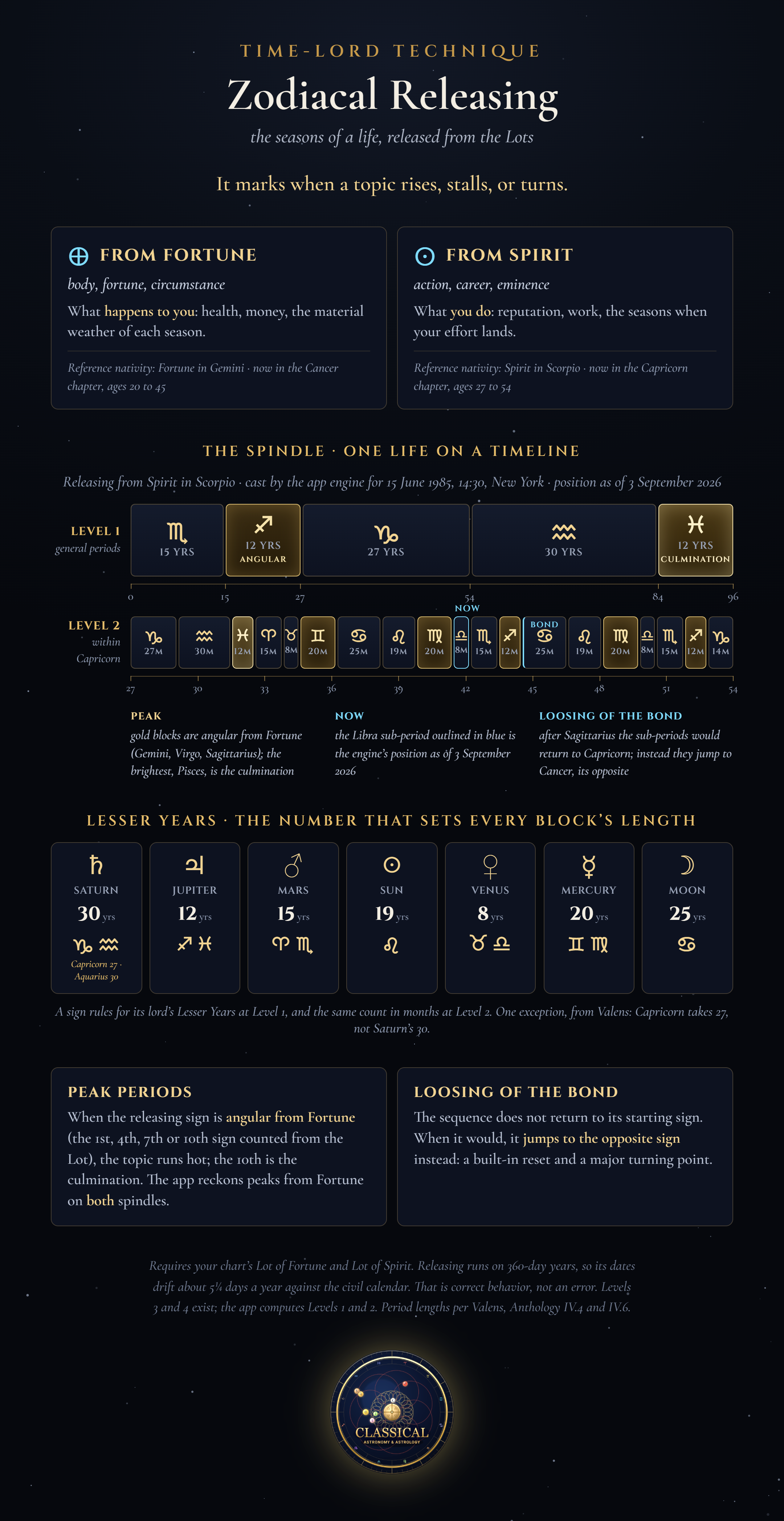
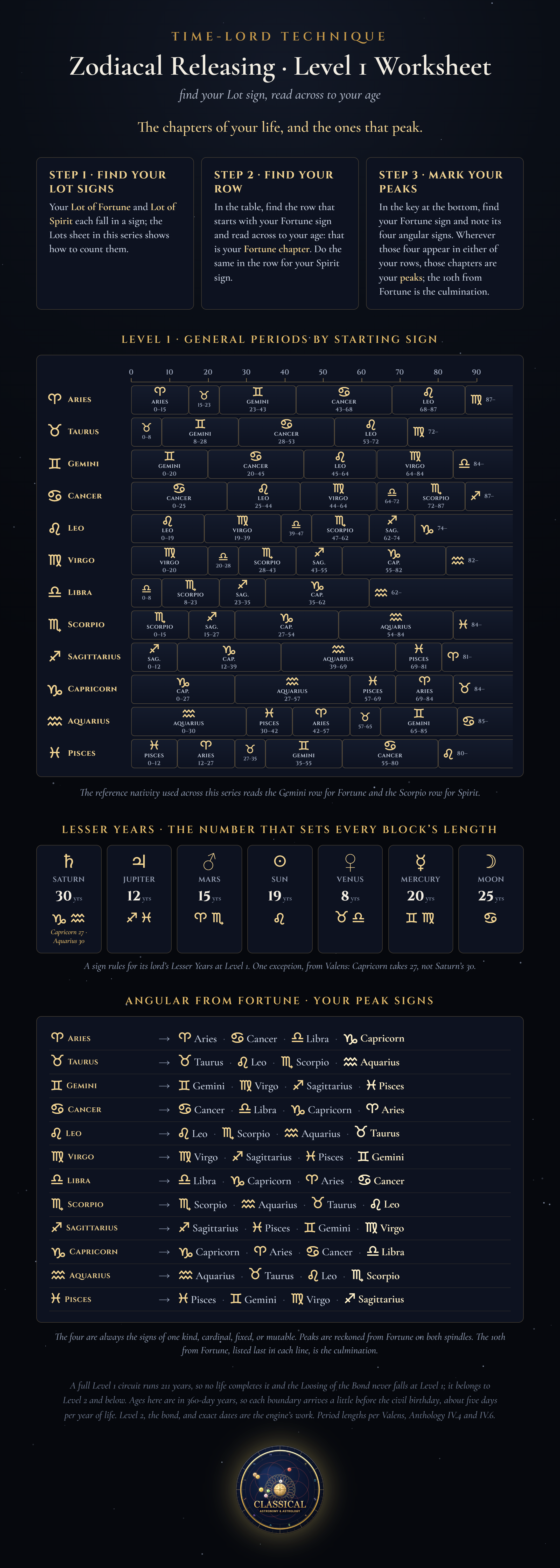
The releasing begins at the Lot's own sign and proceeds in zodiacal order. Each sign holds the times for the count of years its lord is allotted, the Hellenistic minor periods. These are the year counts the app's engine carries.
| Sign | Lord | Years |
|---|---|---|
| Aries | Mars | 15 |
| Taurus | Venus | 8 |
| Gemini | Mercury | 20 |
| Cancer | Moon | 25 |
| Leo | Sun | 19 |
| Virgo | Mercury | 20 |
| Libra | Venus | 8 |
| Scorpio | Mars | 15 |
| Sagittarius | Jupiter | 12 |
| Capricorn | Saturn | 27 |
| Aquarius | Saturn | 30 |
| Pisces | Jupiter | 12 |
Saturn holds the two largest spans, and they differ: Aquarius allots 30 years, Capricorn the reduced 27. One full circuit of all twelve signs runs 15 + 8 + 20 + 25 + 19 + 20 + 8 + 15 + 12 + 27 + 30 + 12 = 211 units. The sub-periods divide each L1 chapter the same way, from the same starting sign, but measured in months on a 360-day distribution year, where 1 month = 30 days.
PEAK PERIODS
The high points are counted from the Lot of Fortune, which stands as a second Ascendant no matter which Lot is releasing. When the releasing reaches a sign angular to Fortune, chiefly the tenth sign from it, the chapter culminates: a period of prominence, activity, and visible standing. The signs one, four, and seven from Fortune are angular too, the succedent signs rising, the cadent signs declining.
At the end of a long chapter the releasing does not simply repeat. Once the sub-periods have run a full circuit of 211 months and would return to the sign that began the chapter, that sign is not taken again. The releasing crosses to the sign opposite the starting sign and continues in zodiacal order with full allotments. This turning is the loosing of the bond, a decisive change of track.
Valens allots the remainder "using the signs in opposition."
What it signifies
The reading is physical and causal, not symbolic. Fortune's releasing colours the body and the outward circumstance of a chapter: health, place, fortune, the conditions handed to a person. Spirit's releasing colours the action and the standing: the work, the office, the deeds a person is doing in those years.
The quality of each chapter is read from its ruling lord as that lord actually sits in the birth chart. A peak chapter ruled by a well-placed benefic that is in its own sect is a fortunate and prominent stretch, the times running with the grain of the life. A chapter, and above all a peak, ruled by a debilitated malefic that is out of sect is a pressed and difficult stretch, the times running against it. The loosings of the bond mark the hinges: the points where the story turns and the tenor of the life changes.
Where the app departs
DEPARTURE FROM PTOLEMY
Zodiacal releasing is not in Ptolemy at all. It appears nowhere in the Tetrabiblos. It is the method of Vettius Valens, post-Ptolemaic Hellenistic doctrine, and the app labels it as such: "Hellenistic Time-Lords (Valens)." The app releases from both Lots, Spirit for action and career by default and Fortune for the body by toggle, and it computes the full peak-period ladder, counting every peak from the Lot of Fortune. It runs the 360-day distribution year of the tradition, so the chapter dates drift against the civil calendar by roughly five and a quarter days per period-year: this is the correct doctrinal behaviour, not an error. The names "zodiacal releasing" and "loosing of the bond" are modern coinages for what Valens describes in plain terms.

Seen in a real chart
Marcus Aurelius was born a night birth, shortly before dawn at Rome. His Lot of Fortune falls at 1 deg 33 min Sagittarius, in the tenth whole-sign house, with Jupiter as its lord. Releasing the body-and-circumstance clock from Sagittarius, the L1 chapters run:
| Period sign | Lord | Years | Age span |
|---|---|---|---|
| Sagittarius | Jupiter | 12 | 0 to 12 |
| Capricorn | Saturn | 27 | 12 to 39 |
| Aquarius | Saturn | 30 | 39 to 69 |
The first chapter, Sagittarius, is ruled by his Jupiter, which holds only its term in Scorpio, a minor dignity, and sits cadent in the ninth house and retrograde: a lord of modest strength. The two long chapters that cover the rest of his life, Capricorn and Aquarius, are both ruled by his Saturn, which stands in its detriment in Cancer in the fifth house. Saturn in detriment is a badly placed lord, so the body-and-circumstance clock runs those decades under a hard, laborious tenor, though the mutual reception between his Saturn and Moon lends the two some standing support.
The culmination peak from Fortune falls on the tenth sign from Sagittarius, which is Virgo, ruled by Mercury. That is where the body-and-circumstance releasing reaches its high point of prominence and activity whenever a period lands there. Marcus died in his late fifties, inside the Aquarius chapter, so the L1 arrival at Virgo lies far beyond his lifespan, and the lived peaks are the Virgo and other angular sub-periods reached inside the chapters above.

How to read it in the app
The releasing appears in the natal reading as the Chapters of Life. It shows two panes, Spirit for action and career as the default and Fortune for the body and circumstance by toggle, and above each timeline a life-map line naming which chapters culminate. Every chapter is drawn as a proportional bar from birth, and each period names its ruling lord together with that lord's condition, sign, house, and dignity, so the reader sees at once whether a chapter runs under a strong or a debilitated lord. A loosing of the bond is marked with a diamond badge on the sub-period that turns. For a living native the app adds a current-chapter card with the sub-period, age range, and next transition date; on a historical chart such as this one that card stays silent, because no period contains today. The same timeline is read by the app's astrologer when it answers questions of timing.
Sources
Vettius Valens, Anthologiae, Book IV (the releasing chapters)
Paulus Alexandrinus, Introduction (construction of the Lots)
Ptolemy, Tetrabiblos IV.2 (the Lot of Fortune)
Robert Schmidt, Project Hindsight (the modern terms)
Chris Brennan, Hellenistic Astrology, 2017 (peak periods)