The Eclipse Catalogue
← Back to the app
Dimbleby · All Past Time · cycle reconstruction
The complete catalogue the app carries: 35,387 solar and lunar eclipses, each located in Dimbleby's repeating pattern — the 18-year team, the Saros and Inex series, the 649-year Date-Repeating Cycle. The next eclipse is found by referencing a date's place in the lattice, not by running an ephemeris. It is deterministic and offline: a single binary search over a sorted column of Julian Days.
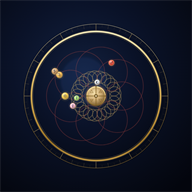
The app's live eclipse clock, running here in your browser. It draws the real sky for the moment shown, the Sun and Moon on the ecliptic and the dragon's head and tail (the lunar nodes) that gate every eclipse. Scrub the date or press play to watch the nodes regress and the eclipse seasons come round. Everything on the wheel is named in the anatomy panel below, and lights up when you point to it.
The cycle Dimbleby counted
Eclipses repeat in a ladder of exact whole-number periods. Know an eclipse's rung and you know when its whole family comes back — no gravitation, just counting.
Anatomy of the wheel
Point to any part to light it up on the clock.
On eclipses
Eclipses are the most consequential events in mundane astrology. Where ordinary transits modify everyday affairs, eclipses signal great public movements: wars, climates, dynastic shifts, the rise or fall of cities. Their force is geographical, not personal. An eclipse belongs to the regions of the world ruled by the sign in which it falls.
Three geometric conditions must coincide for an eclipse to fire, and each closes a window the previous one opens. First, the lunar nodes: the Moon must stand within about 17 degrees of where its orbit crosses the Sun's path. Second, the Moon's phase: new for a solar eclipse, full for a lunar. Third, the alignment of the two luminaries: exact conjunction for a solar eclipse, exact opposition for a lunar. Only when all three coincide does the body of one luminary cross the other, or Earth's shadow cross the Moon.
Once an eclipse fires, four questions decode its significance. Where on the ecliptic it falls names the geographical triplicity it strikes. Who is the eclipse lord, the planet with the strongest essential dignity at the moment, colours the whole judgement. What aspects the eclipse degree mitigates or amplifies, benefics softening and malefics sharpening. And how long it lasts: a solar eclipse gives one year of effect for each hour of obscuration, a lunar one month per hour, the deepest effects near the beginning.
After 6585.32 days, about 18 years, 11 days and 8 hours, the Sun, Moon and node return to a nearly identical configuration, and an eclipse of nearly the same type, longitude and duration repeats. Ancient astronomers used the Saros to predict eclipses centuries in advance, and this wheel reproduces the same mechanical relationships in its gearing.
Where did the cycle math come from? Read the full Dimbleby cycle system →
The wheel encodes the geometry that decides whether an eclipse is possible at all. The dragon hand is the gating condition. Most months it sits too far from the Sun and Moon line, and no eclipse can fire. Twice a year, for about a month, it sweeps into the eclipse-season window and the doctrine begins watching. When the three conditions above all read met, the next syzygy will produce an eclipse somewhere on Earth, with consequences readable in the sign and the lord.
Doctrine after Ptolemy, Tetrabiblos II.4 to II.9 (Ashmand 1822). The eclipse dates and the Dimbleby ladder are drawn from the catalogue on this page.
| Gregorian | Dimbleby | Type | Member | Team·Line | 649#·Yr | A.M. |
|---|
Select a row to read its full place in the wheels.
| Gregorian | Type | Mag | γ | Saros | Team·Line | Member | Confidence |
|---|
Select a row to inspect an eclipse.
| # | Gregorian | Type | γ |
|---|
 The Eclipse Catalogue