 Classical Astronomy & Astrology
What it is
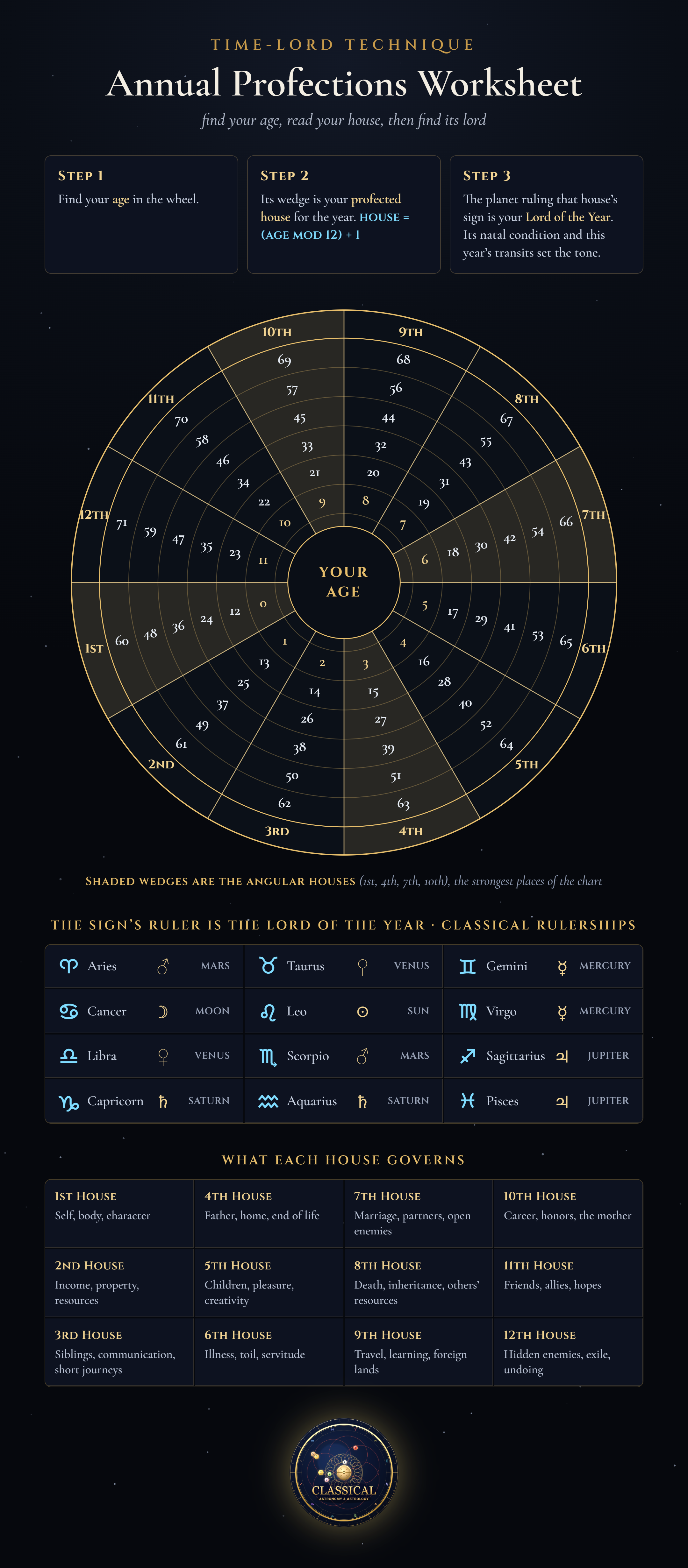
Annual profection, the technique that finds your lord of the year, is the simplest of the timing methods: it walks the twelve places of the chart at the rate of one sign per year of life, and asks which part of life this particular year is about.
The word means "moving forward." At birth the count rests on the first place, the rising sign. On the first birthday it steps forward one whole sign to the second place; on the second, to the third; and so on around the circle. Twelve years carry it once around the whole wheel, and the thirteenth year returns it to the rising sign to begin again. So every place is visited once in each twelve-year turn, and the age alone tells you where the count now stands.
The sign the count lands on is the profected place, and it names the topic: the field of life the coming twelvemonth chiefly concerns. The planet that rules that sign by domicile becomes the lord of the year, the single governor to whom the twelvemonth is handed. Read that governor's own condition in the birth chart and you have the character of the year: whether its topic is met warm or cold, supported or strained.
How the tradition computes it
The count begins at the Ascendant and advances one sign for each completed year. In the app the whole calculation reduces to four lines. Sign indices run from Aries at 0 to Pisces at 11.
a = age mod 12
profected house = a + 1
profected sign = (ascSign + a) mod 12
lord of the year = domicile ruler of the profected sign
The step a is the position within the twelve-year wheel, so age 0 sets the count on the first place, age 1 on the second, and age 12 returns it to the first. The lord of the year is read off the ordinary table of domiciles (Tetrabiblos I.20): whichever of the seven planets owns the profected sign takes the year.
| Profected sign | Lord of the year (domicile ruler) |
|---|---|
| Aries | Mars |
| Taurus | Venus |
| Gemini | Mercury |
| Cancer | Moon |
| Leo | Sun |
| Virgo | Mercury |
| Libra | Venus |
| Scorpio | Mars |
| Sagittarius | Jupiter |
| Capricorn | Saturn |
| Aquarius | Saturn |
| Pisces | Jupiter |
What it signifies
The profected place tells you the subject of the year; the lord of the year tells you its quality. A benefic in good condition taking the year, say warm and moist Venus or Jupiter, and set strong by dignity and place, gives a temperate and fruitful passage through its topic. A malefic taking the year, hot and dry Mars or cold and dry Saturn, or any planet fallen into detriment, fall, or combustion, gives a harder, drier, or colder year in that field.
Because the governor is a real body in a real chart, its birth condition is decisive. The lord of the year does not act freshly; it acts as it stands natally, and the year inherits that standing. A year is intensified further where the profected sign is tenanted by natal planets, for the count then falls on an already crowded place, and where the transiting planets of the moment meet the year's governor.
Where the app departs
Where the app departs
Profection as such, the fixed schedule of one sign per year, is Hellenistic practice, set out and used by Vettius Valens in the Anthologiae and by Paulus Alexandrinus, and systematised after Ptolemy. The app anchors the method to the Tetrabiblos chapter on the division of times (Tetrabiblos IV.10), which treats how the periods of life are apportioned among the governing places, but it states plainly that the one-sign-per-year schedule itself is post-Ptolemaic Hellenistic practice rather than an instruction of Ptolemy's own. The app also refuses the fatalistic reading: it marks a twelvemonth as activated, and it will not issue a date-stamped prediction.

Seen in a real chart
Marcus Aurelius is born shortly before dawn with Pisces rising, a nocturnal chart, so the first place, and the origin of the count, is Pisces, whose index is 11. Take a representative adult year, age 38, and run the formula.
a = 38 mod 12 = 2
profected house = 2 + 1 = 3
profected sign = (11 + 2) mod 12 = 1 = Taurus
lord of the year = domicile ruler of Taurus = Venus
The year lands on the third place and hands the twelvemonth to Venus. Reading Venus from the bundle: she is exalted in Pisces (Tetrabiblos I.22), angular in the first place, and she is the lord of the whole chart, scoring essential +4 and accidental +6, in a tight applying trine to Jupiter of about 1.9 degrees. A year whose governor is the exalted, angular chart lord is a strong and temperate year in the matters of the third place: brothers and neighbours, near journeys, and daily words and writing. The reading is reinforced twice over, because the profected sign Taurus is tenanted natally by the Sun, Mercury, and Mars, so the year falls on a crowded place and draws their matters forward with it.
The app then escalates a transit of the year when the transiting body is Venus herself, the lord of the year, when a transit contacts natal Venus in Pisces, or when a transiting body enters Taurus, the profected sign. Any of the three raises that transit's tier. What the app will not do is name the day: it opens an activated window and leaves it at that.
How to read it in the app
The annual profection appears in the Horoscope reading, which prints the profected house, the profected sign, and the lord of the year together with that lord's natal dignity and place, for example the tenth place in Sagittarius under Jupiter as lord. A citation footnote resolves to Tetrabiblos IV.10, the division-of-times chapter the method is anchored to, so the reader sees the source beside the activated window rather than a dated forecast.
Sources
Tetrabiblos IV.10, The Periodical Divisions of Time. Ptolemy, trans. J. M. Ashmand, London, 1822. The division-of-times chapter the method is anchored to.
Tetrabiblos I.20, Houses of the Planets. Ashmand, 1822. The domicile rulerships that yield the lord of the year.
Tetrabiblos I.22, Exaltations. Ashmand, 1822. Venus exalted in Pisces in the worked example.
Vettius Valens, Anthologiae. The one-sign-per-year annual schedule as practised in the Hellenistic tradition.
Paulus Alexandrinus, Eisagogika (Introduction). The profection schedule as taught after Ptolemy.