 Classical Astronomy & Astrology
What an aspect is
An aspect is a relationship of regard between two of the seven planets — a line of sight along which their natures reach one another. Ptolemy sets that regard by the signs the planets occupy, not by their exact degrees. Two bodies are configured the moment their signs stand in one of a small, fixed set of whole-sign relationships; because every sign is a full thirty degrees wide, the bond exists as soon as the planets fall in the right pair of places, whatever their precise longitudes.
The older word for it is marturia, testimony, and epimarturia, bearing-witness: two planets that are configured witness each other and so can act together, for help or for harm. Two that are not configured are averse — strangers that cannot see one another and therefore neither help nor hinder. Everything the tradition says about aspects rests on this: an aspect is first a fact of sight, and only second a matter of degree.
There are five, counted by how many signs separate the two places: the conjunction (one shared sign), the sextile (two signs), the square (three), the trine (four), and the opposition (six). Every remaining separation — of one sign or of five — forms no aspect at all. The degree a planet holds within its sign is never thrown away, but it only refines a bond the signs have already made. Sign first, degree second.
Why exactly five: the geometry
The five are not an arbitrary list. Each is a way of dividing the circle by a whole number, and the figure that division inscribes is the aspect’s emblem. Ptolemy draws them from the concordant ratios — the same simple proportions that make a musical interval sound in tune. Halve the circle and you have the opposition; take a third and a two-thirds and you have the trine and sextile; take a quarter and three-quarters and you have the two squares. What lies between these clean divisions makes no figure, and so makes no aspect.
Read the emblems and the doctrine follows from them. The triangle and the hexagon join places of one kind — all masculine or all feminine, of shared or agreeing element — and so are called harmonious. The square joins places of contrary kind and quadruplicity and so is discordant. The opposition sets two places on one diameter, facing across the whole width of the world, contrary yet bound. The conjunction is no distance at all: one place, two natures fused. This is the whole of the classical scheme — five figures, one for each concordant division of the round.
The five configurations, one by one
Each configuration is read the same way in three passes. First the figure — harmonious or hard, by the kinds of sign it joins. Then the planets — which two natures are meeting, benefic or malefic, and in what dignity. Then the degree — applying or separating, tight or wide. What follows takes each in turn, with the reading the classical authors give it and the sense a modern reader can hold beside it. The card shown with each is the aspect’s own card from the app, where every configuration in a chart is drawn and read this way.
Conjunction
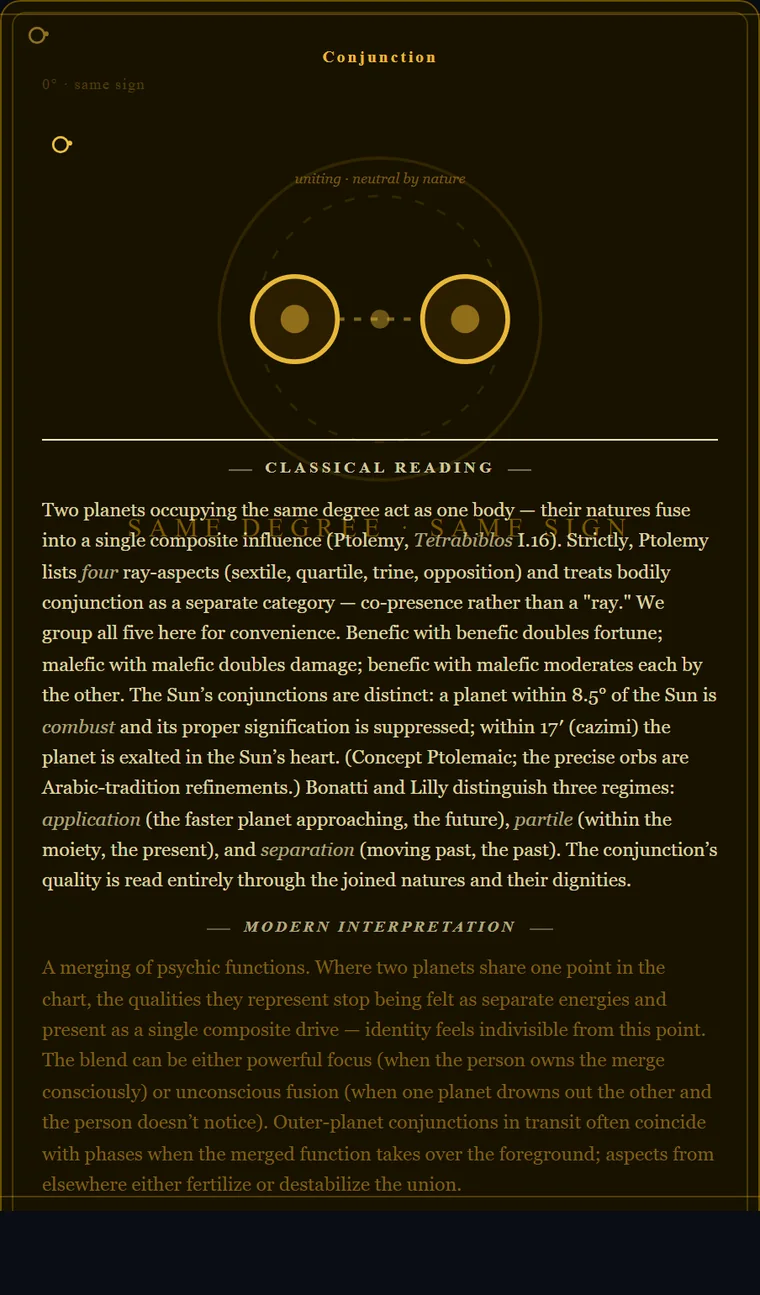
0° · one sign · neutralTwo planets in the same sign — and, tightly, the same degree — act as one body. Their natures do not merely regard one another; they fuse into a single composite influence (Tetrabiblos I.16). The conjunction has no figure of its own because a place cannot be configured with itself; its power is the plainest of all and the hardest to stand outside of.
Classical reading
The blend takes its whole character from who is present. Benefic with benefic — Jupiter with Venus — doubles fortune; malefic with malefic — Mars with Saturn — doubles the damage; a benefic with a malefic tempers or corrupts by turns, the stronger and better-placed prevailing. When one of the two is the Sun the meeting becomes a matter of the solar phases rather than of aspect: within about eight and a half degrees the planet is combust, scorched and hidden; within seventeen minutes it is cazimi, in the very heart of the Sun, and instead of burning is exalted. Bonatti and Lilly weigh the meeting by its regime — a planet still applying to the conjunction, one partile and exact, and one already separating and spending its force.
Modern sense
A merging of two psychic functions into one gesture. Where the planets agree it reads as concentrated power and single-mindedness; where they do not, as an unconscious fusion the person mistakes for one thing — a drive they cannot see because they are standing inside it. The conjunction is rarely felt as a relationship; it is felt as a fact of temperament.
Sextile
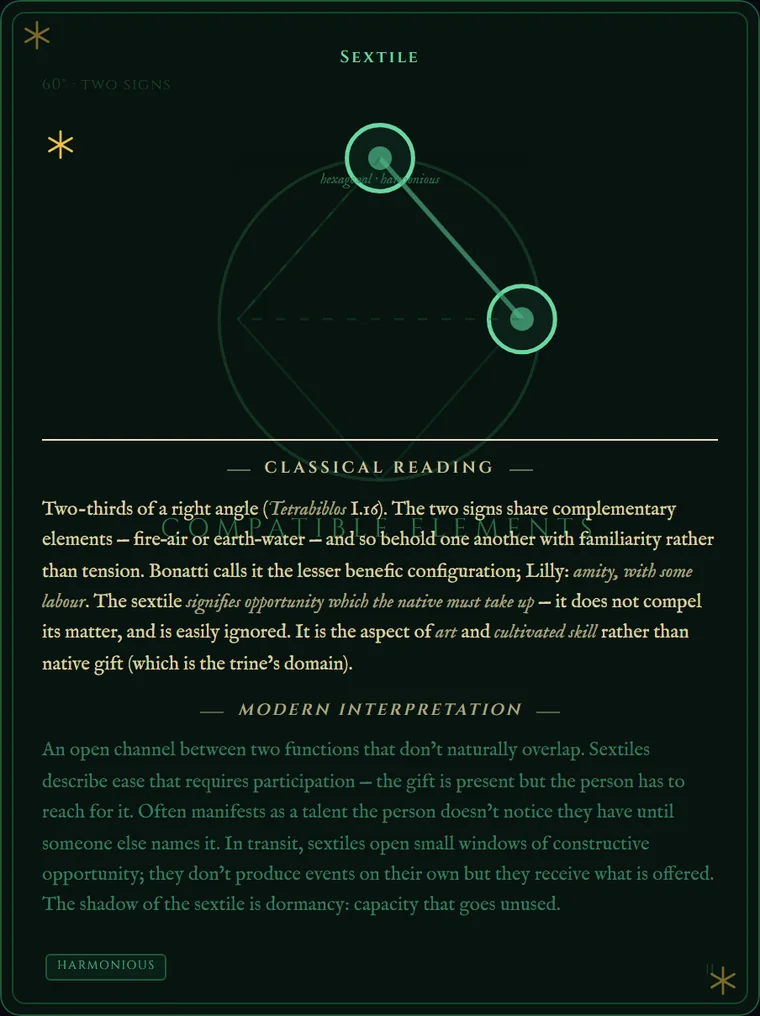
60° · two signs · harmoniousTwo-thirds of a right angle, and the emblem is the hexagon. The two signs stand two apart and so share a complementary element — fire with air, or earth with water — and behold one another with familiarity rather than tension (Tetrabiblos I.16).
Classical reading
Bonatti calls it the lesser benefic configuration; Lilly, amity, with some labour. That last phrase is the whole of it: the sextile signifies opportunity which the native must take up. It does not compel its matter and is easily let slip. It is the aspect of art and cultivated skill — a good thing available to the one who reaches for it — rather than of native gift, which is the trine’s domain. A benefic in sextile offers; a malefic in sextile is the milder face of a hard planet, a difficulty that can be worked with.
Modern sense
An open channel between two functions that do not naturally overlap — ease that requires participation. The gift is present but the person has to reach for it, and it often shows up as a talent they do not notice they have until someone else names it. Its shadow is dormancy: a capacity that goes unused because nothing forced the hand.
Square
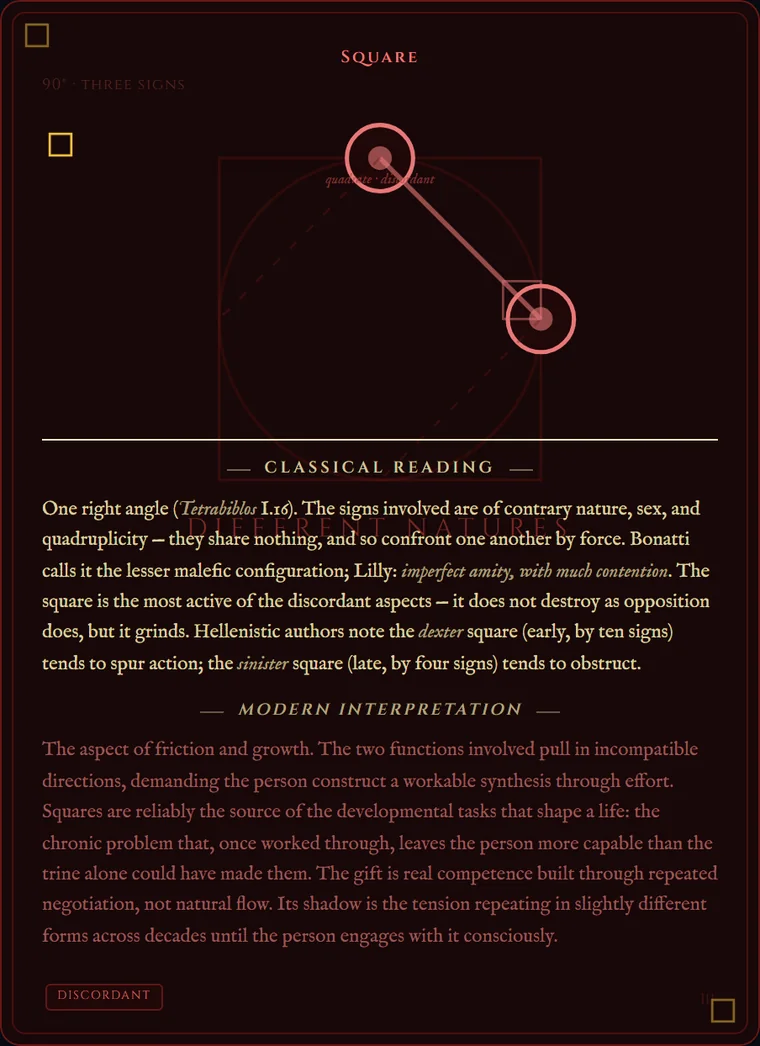
90° · three signs · discordantOne right angle, and the emblem is the tetragon. The two signs stand three apart, in contrary nature, sex and quadruplicity — cardinal against cardinal, or fixed against fixed, but of clashing element and polarity — and so pull against one another (Tetrabiblos I.16).
Classical reading
Bonatti calls it the lesser malefic configuration; Lilly, imperfect amity, with much contention. The square is friction with a use: it is where two parts of a life are forced into the same room and must contend. The hand matters more here than elsewhere. A dexter square — cast against the order of the signs, from the earlier place — tends to spur, to press for action; a sinister square, cast with the order from the later place, tends to obstruct. A benefic’s square still gives its good, but with labour; a malefic’s square is the tradition’s plain image of an obstacle to be overcome.
Modern sense
The aspect of friction and growth — the developmental tasks that shape a life. A square is not a verdict of failure but a demand for work: the two functions cannot be left to their own devices, and the tension between them is exactly what builds capacity. Charts without squares tend to lack the grit that makes the softer aspects do anything.
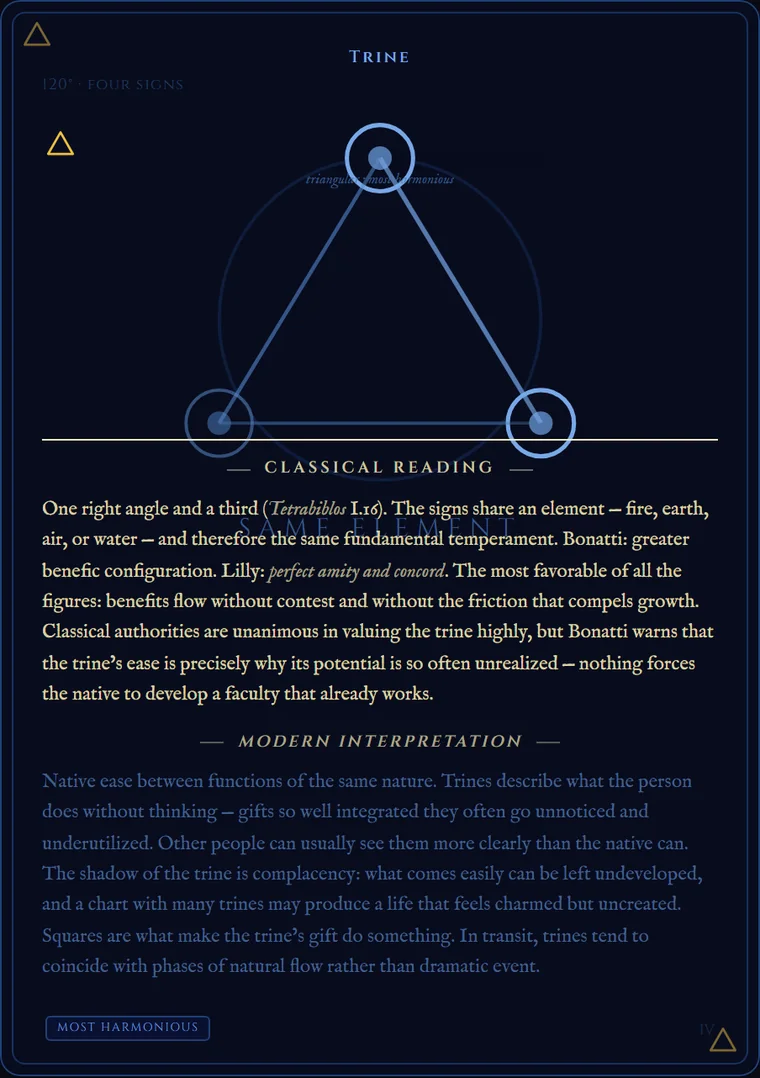
Trine
120° · four signs · most harmoniousOne right angle and a third, and the emblem is the triangle. The two signs stand four apart, in the same element — the surest agreement in the zodiac — and so flow into one another without resistance (Tetrabiblos I.16).
Classical reading
Bonatti calls it the greater benefic configuration; Lilly, perfect amity and concord. The trine is native gift — a good that is simply there, given rather than earned. And here Bonatti sounds a warning the modern reader should keep: the trine’s very ease is why its potential is so often unrealised. What costs nothing is easy to neglect. A benefic in trine is fortune at its most reliable; even a malefic in trine gives its better side, its discipline or its courage, with far less of its sting.
Modern sense
Native ease between two functions of the same nature — a talent that works on its own and asks nothing. Its shadow is complacency: the gift runs so smoothly that it is taken for granted and never pushed. It is the squares in a chart, oddly, that make a trine’s gift do something — the ease needs a demand to spend itself on.
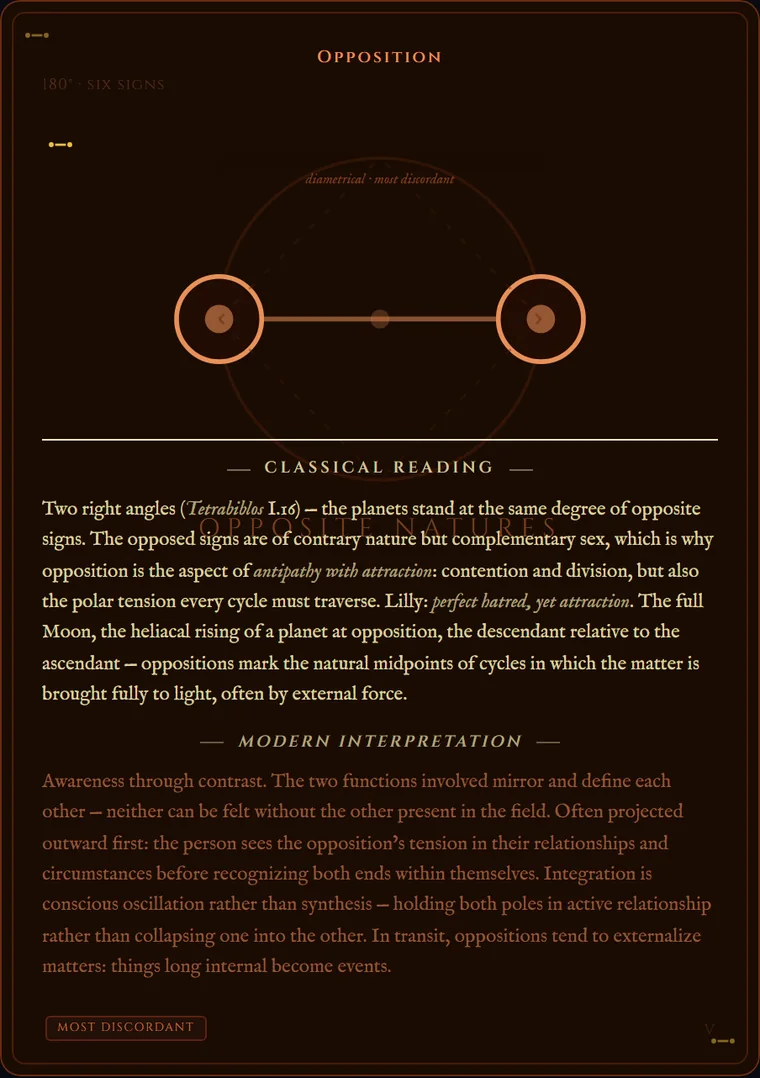
Opposition
180° · six signs · most discordantTwo right angles, the whole diameter, and the emblem is the axis itself. The two signs stand six apart, of contrary nature but complementary sex — each the other’s opposite and each the other’s counterpart — and so face across the full width of the circle (Tetrabiblos I.16).
Classical reading
Lilly gives it as perfect hatred, yet attraction — the aspect of antipathy that cannot look away. It is the geometry of every confrontation the sky can stage: the full Moon opposite the Sun, a planet rising heliacally as the Sun sets, the descendant facing the ascendant. Two planets in opposition are bound to a single axis and can neither merge nor escape; the reading turns on which of the two holds the upper hand — by dignity, by sect, by house — for the stronger tends to draw the matter to its own side.
Modern sense
Awareness through contrast — two functions each defined by the other. The opposition is the most likely of all aspects to be projected: the far pole is felt first as other people, as circumstance, as the thing done to you, before it is recognised as one’s own. Its resolution is not synthesis but conscious oscillation — learning to stand at each pole in turn rather than being pulled between them.
Aversion, the sixth relationship
Two places are averse when they stand one sign apart or five signs apart — thirty degrees or a hundred and fifty. They share no element, no sex, no quality and no polarity, and so cannot behold one another at all (Tetrabiblos I.16). Aversion is not a faint aspect to be measured with a small orb. It is the negation of aspect — the absence of the relationship, not a weak instance of it.
This is the single point on which the classical scheme parts most sharply from later practice. A modern astrology treats the thirty-degree gap as a semisextile and the hundred-and-fifty as a quincunx or inconjunct, faint contacts to be interpreted. The classical tradition does not: to it these are precisely the two distances at which two planets are strangers. A planet in the twelfth sign from another, or the sixth from it, testifies nothing to it — which is exactly why the second, sixth, eighth and twelfth places, the ones averse to the rising sign, are the tradition’s difficult houses.
Modern sense
Two functions that operate side by side with no conversation between them — not in conflict, simply out of contact. Where a later reader looks for an adjustment to be made across the quincunx, the classical reader finds nothing to adjust, because there is no channel there to carry the strain.
Applying and separating
A configuration is a standing fact of the signs; whether it is gathering or spent is a matter of motion. Within any aspect the swifter of the two bodies decides the direction of the contact.
the planet which precedes is said to apply to that which follows (Tetrabiblos I.27)
When the faster planet is still closing the exact angle the aspect is applying, and its effect is gathering toward a peak; once it has passed the angle and is drawing away the aspect is separating, and its effect is passing off. An applying aspect is a thing coming; a separating one is a thing done. For a bodily conjunction the latitudes are weighed as well, so that only a true meeting in the same part of the zodiac counts; for the other four aspects the rays converge alike from every quarter and latitude is set aside.
Orbs, moieties and the hand of the ray
A contact exact to within a single degree is partile; a wider one, still within reach, is platic. Reach is set by the orbs. In the medieval refinement each body carries a full orb — a sphere of its own light — and its moiety is half of that. Two planets are within orb of each other when the distance between them is no more than the sum of their two moieties:
effective orb = orb(A) / 2 + orb(B) / 2
| Body | Full orb | Moiety |
|---|---|---|
| Sun | 17° | 8.5° |
| Moon | 12.5° | 6.25° |
| Jupiter | 12° | 6° |
| Saturn | 10° | 5° |
| Venus | 8° | 4° |
| Mars | 7.5° | 3.75° |
| Mercury | 7.5° | 3.75° |
So the Sun and Jupiter, with moieties of eight-and-a-half and six degrees, share a fourteen-and-a-half-degree reach; two lesser lights reach barely half as far. A whole-sign contact that runs wider than about eight degrees is read by sign only — the configuration stands, but its degree-strength is set aside as too loose to press.
The hand of the ray
Every ray but the conjunction and the exact opposition has a hand. A dexter ray is cast against the order of the signs, back toward an earlier place; a sinister ray is cast with the order, forward toward a later one. The tradition reckons the dexter the stronger of the two — the right-handed blow — which is why the dexter square is read as the more forceful and the sinister square as the more obstructive. It is the same aspect by figure; the hand tells you how it strikes.
The Sun’s phases, a power apart
Nearness to the Sun is not an aspect. It is a separate condition of a planet, measured by plain distance in longitude, and it can override much of what the aspects say. A planet drowned in the beams cannot give its testimony cleanly, however well it is configured.
| Phase | Within | Effect |
|---|---|---|
| Cazimi — in the heart of the Sun | 0° 17′ | a great strengthening |
| Combust — burnt | 8° | hidden, scorched, weakened |
| Under the beams | 15° | dimmed, not yet free of the glare |
The distances are the medieval measure — eight degrees for combustion, fifteen for the beams, seventeen minutes for cazimi — and the app reads them as such alongside the classical configuration.
The mixing of natures
An aspect is a channel; the planets are what flows through it. Every configuration mixes two of the four qualities — heat and cold, moisture and dryness — and the kind of sign the figure falls across decides whether that mixing is easy or strained. Trine and sextile join signs of one kind and let the natures blend; square and opposition join signs of contrary kind and set them at odds.
Then the planets colour the result. A trine or sextile from Jupiter or Venus, the benefics, tempers and warms; a square or opposition from Mars or Saturn, the malefics, heats to excess or chills and dries. But the figure and the planet can pull opposite ways, and reading the aspect well means holding both at once: a benefic’s square gives its good but only with labour, while a malefic’s trine gives its discipline or courage with little of its sting. Sect tips the balance again — the malefic of the sect in favour is half-tamed, the malefic contrary to sect is at its worst — which is why the same square can read as a spur in one chart and a wound in another.
The rule of thumb
Judge an aspect in three moves and in this order: the figure (harmonious or hard), the planets (benefic or malefic, and whether in or out of sect), and the degree (applying or separating, tight or wide). A hard figure between gentle, well-placed, separating planets is a small matter; a soft figure between a wounded malefic and the sect light, applying and partile, is not.
Reception and the light between planets
Beyond the single aspect, the tradition reads the traffic of light among several planets — the figures that Bonatti and Lilly gather under the judgment of questions and apply as readily to a nativity. These are where the aspects stop being a list and start being a story. This is the deep water the app’s reading draws on, and the ground the beginner most often misses.
Reception
An aspect lands very differently depending on whose house the planets stand in. A planet receives another when the second falls in a sign of the first’s dignity — its domicile or exaltation above all. Mars square Venus is a raw clash; but if that Mars sits in Libra or Taurus, Venus’s own signs, then Venus receives Mars, and the hard aspect is softened as a host softens a difficult guest. Mutual reception — each planet in the other’s dignity — is the strongest form: two planets that dislike each other by figure can still do business because each is at home in the other’s house.
Translation of light
A swift planet can carry the light of one slow planet to another that it does not itself aspect. The Moon separating from a trine to Saturn and applying to a sextile of Venus translates Saturn’s testimony to Venus — a go-between, a messenger, a third party who brings two matters together that would not otherwise have met. In timing and in questions it is the classic figure of the intermediary.
Collection of light
Where translation carries the light along, collection gathers it in. Two planets that do not behold each other can still be joined if both cast their rays to a third, heavier planet that receives them — the weightier body collects the two testimonies and binds the matter. The figure of the arbiter, the person or condition that settles what the principals cannot settle between themselves.
Prohibition, refranation and besieging
Not every applying aspect completes. Prohibition is a third planet interposing its own aspect before the first two perfect theirs — the matter blocked or taken by another hand. Refranation is one of the two turning retrograde or falling under the beams before the angle is exact — the applying planet drawing back, the thing almost done and then abandoned. Besieging, or enclosure, is a planet hemmed between the bodies or rays of both malefics with no benefic to relieve it — pressed on either side, with the aspects reading as a trap rather than a channel. These are the classical grammar of an aspect that does not go the way its figure promises.
Why there are no minor aspects
The classical scheme is complete at five, and it is worth being exact about why. The distances a later astrology treats as faint aspects fall into two groups, and neither survives the classical test.
The thirty-degree and hundred-and-fifty-degree contacts — the modern semisextile and quincunx — are not weak aspects but the two aversions: precisely the separations at which two signs share nothing and cannot behold each other. To read them as contacts is to read a relationship where the tradition finds its absence.
The rest — the semisquare of forty-five degrees, the sesquiquadrate of a hundred and thirty-five, the quintile of seventy-two, the biquintile of a hundred and forty-four — come from a later, harmonic way of dividing the circle by fives and eighths. They belong to a different instrument. Our reading engine holds to the five and to aversion; the wheel will draw the minor angles for those who want to see them, but they are drawn, not read, and no judgment rests on them. The five configurations and the aversion are the whole alphabet the classical reading is written in.
Seen in real charts
In the chart of Marcus Aurelius the tightest applying aspect is Venus trine Jupiter, at 1.9° applying. Venus sits in Pisces in the first house, exalted and the chart lord; Jupiter sits in Scorpio in the ninth, retrograde and in its term. Pisces and Scorpio stand four signs apart, so the trine exists by sign; the 1.9° then refines it. Venus, the swifter body, is still closing, so the aspect is applying — a benefic trine, the greater benefic configuration, gathering strength. Their moieties, four degrees and six, give a ten-degree reach, so at 1.9° the contact sits well within orb, tight but not yet partile.
Reading the three passes
Figure: a trine — the same element, perfect concord. Planets: Venus, exalted and the chart lord, to Jupiter, the greater benefic — two benefics, the most fortunate pairing there is. Degree: applying and inside orb. This is native gift at its most reliable, and being the tightest aspect in the chart, it colours the whole nativity.
Aversion is easier felt than found here: all seven planets fall in feminine signs, so no two of them are averse, and each regards every other — a remarkably woven chart. But the Midheaven sign, Sagittarius, is masculine, and the Sun in Taurus stands five signs from it, in aversion to the tenth place — a career whose honours the native cannot quite look at directly. For the Sun’s phases, Mars gives the plain case: it lies 4.1° from the Sun, inside the eight-degree orb, and so is combust — the lesser malefic scorched by the beams, its testimony muffled.
The layered classical tradition
Classical astrology is not one author but a settled composite — Hellenistic, then medieval — and the aspects show the layers plainly. It helps to know which hand gave which part, because the parts are cited, not apologised for.
- The whole-sign configuration itself, the five figures and their harmonious-or-hard natures, is Ptolemy’s, in Tetrabiblos I.16, with applying and separating in I.27.
- The numeric orbs and the moiety method are the medieval refinement — the working figures come to us through Guido Bonatti — used to weigh a contact’s strength once its existence is settled by sign.
- The combustion and under-the-beams distances follow the Arabic tradition, Abu Ma’shar and his heirs.
- The benefic and malefic grading of each configuration, and the amity / contention / hatred language, are Bonatti’s and Lilly’s.
The engine keeps these distinct where it matters — the existence of an aspect is decided by sign, on Ptolemy’s frame; the degree-strength, the orbs and the solar phases are the tradition’s numeric refinements, named to their sources and used because they are useful in reading strength.
Reading it in the app
The natal reading lists each configuration by its sign-distance, marks it applying or separating with the degree of application, and flags a wide contact as read by sign only — so a partile bond and a merely-present one can be told apart at a glance. Tap any aspect and its card opens: the figure, the harmony tag, and both the classical reading and the modern sense you have seen throughout this page. The five configurations and aversion drive the judgment; the wheel draws the minor angles for those who want them, but no reading rests on them.
Sources
Ptolemy, Tetrabiblos I.16 — “Of the Configurations of the Planets,” the five configurations and their harmonious or discordant natures. Trans. J. M. Ashmand, London 1822 (the Proclus paraphrase, the edition of record).
Ptolemy, Tetrabiblos I.27 — application, separation and the other faculties. Ashmand, 1822.
Ptolemy, Tetrabiblos, Book III — the Sun’s heliacal phases. Ashmand, 1822.
Guido Bonatti, Liber Astronomiae (thirteenth century) — orb and moiety practice; the benefic/malefic grading of the configurations; reception, translation and collection of light, prohibition and refranation.
William Lilly, Christian Astrology (London, 1647) — the amity / contention / hatred language and the doctrine of the aspects in judgment.
Abu Ma’shar al-Balkhi (ninth century) — the combustion and under-the-beams distances.
Antiochus of Athens; Porphyry, Introduction to the Tetrabiblos — the Hellenistic ground of aversion, testimony and cosmic condition.