 Classical Astronomy & Astrology
Timing does not create events. It activates what the birth chart already promised.
If the birth chart does not promise marriage, no eclipse falling on the seventh house will manufacture one. For that reason the reading of the birth chart always comes first. The timing layer only tells you when a promised matter ripens, and how strongly.
The key terms
Defined once, in plain language, so the stages can lean on them without interruption.
- Ephemeris
- A table of the exact positions of the Sun, Moon and planets for any moment. Every placement here is computed against a real ephemeris, so it is physically accurate rather than approximate.
- Ascendant & Midheaven
- The degree of the zodiac rising in the east at birth (the anchor of the whole chart), and the highest point (career, public standing). Both depend on an exact birth time and place; an error of one hour moves the Ascendant about fifteen degrees.
- Whole-sign houses
- Each sign is one whole house. The Ascendant's sign is the entire first house, the next sign the second, and so on, so the ruler of a sign and the ruler of its house are one and the same.
- Sect
- Whether the chart is a day chart (Sun above the horizon) or a night chart. Sect decides which luminary leads and which of the two difficult planets is the harsher one in this life: the out-of-sect malefic.
- Dignity
- How well a planet sits by sign: strong and functioning, or weakened. Dignity gives the condition of a planet, which governs how well or badly its themes express.
- Lord of the Nativity
- The single planet that best governs the chart as a whole: its steward, the general tenor and direction of the life.
- Significator
- The planet or point that stands for the matter asked about. Marriage: the seventh house, its ruler, Venus, and the Lot of Eros. Career: the tenth house, the ruler of the Midheaven, the Lot of Spirit, the planets of action. You must know what stands for a thing before you can time it.
- Lots (Arabic Parts)
- Calculated points. Two matter most: the Lot of Fortune (body, livelihood, circumstance) and the Lot of Spirit (career, action, purpose). These are the release points for the main long-range technique.
- Timelord (chronocrator)
- A planet that rules a defined stretch of time. Timing works by handing successive periods of a life to different planets; the ruler of the current period is its timelord, and its condition colours that period.
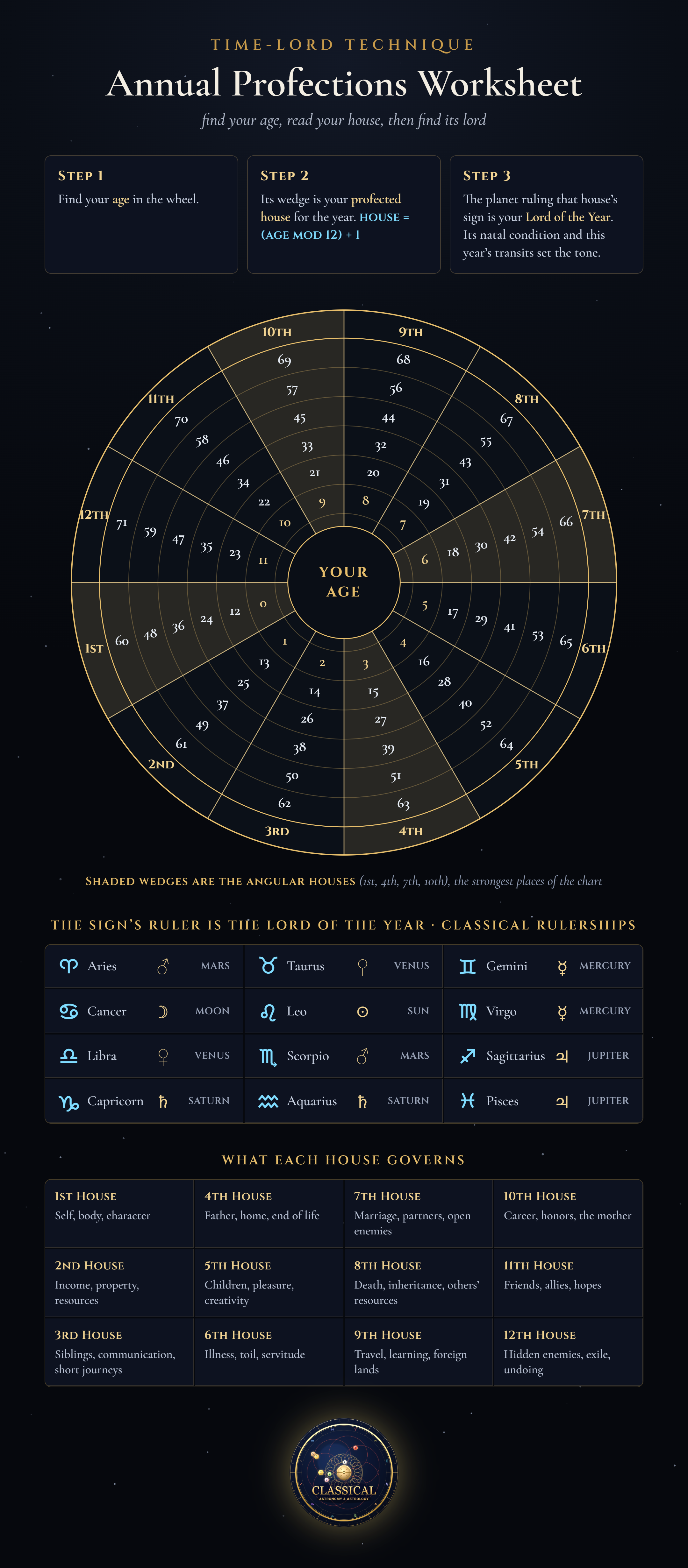
- Annual profection
- The simplest timing technique. Each year advances the focus one sign and one house from the Ascendant; that sign's ruler becomes the Lord of the Year, steering the twelve months ahead.
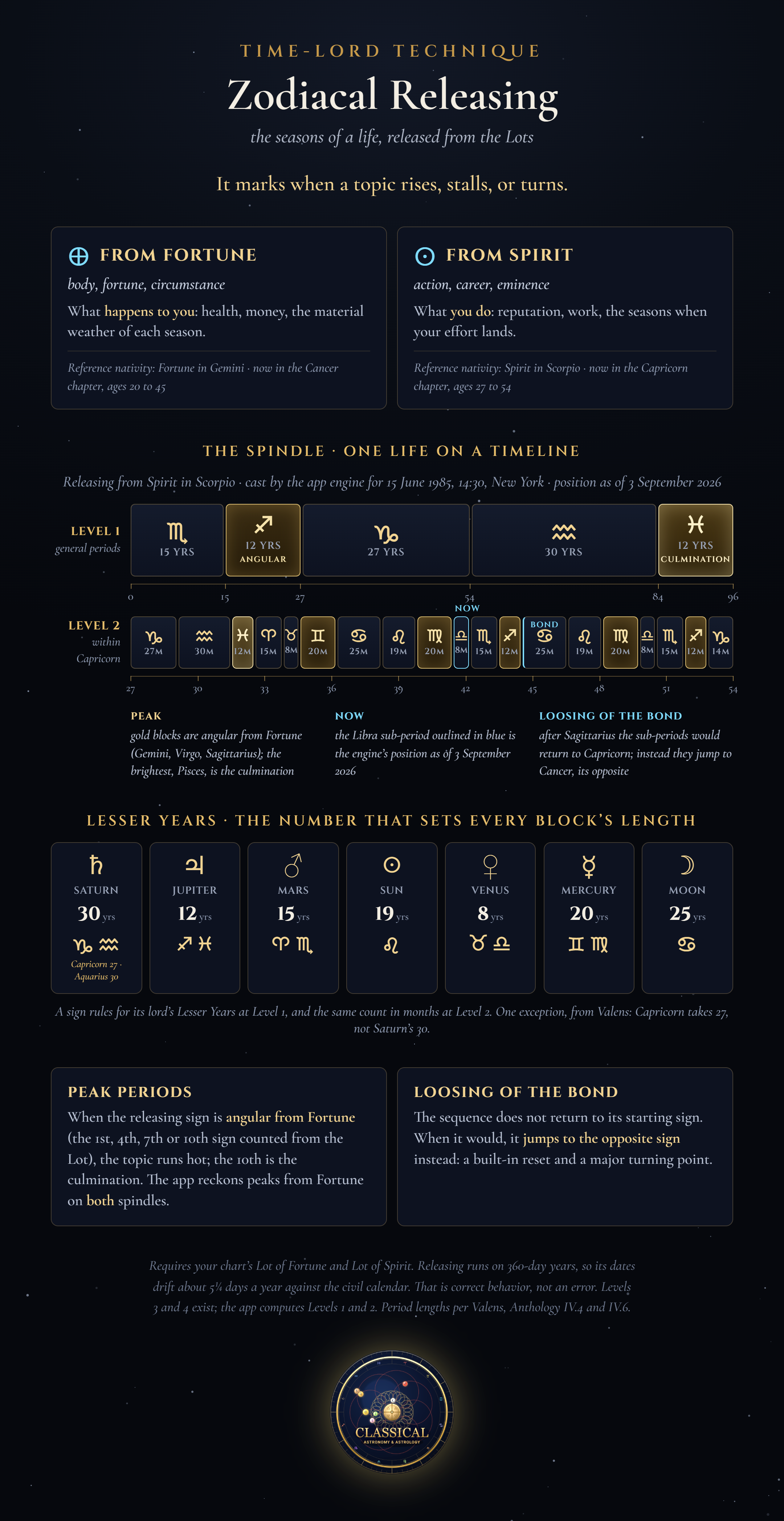
- Zodiacal releasing
- Divides a life into chapters and sub-periods released from the Lots (Spirit for career and purpose, Fortune for body and circumstance). It reveals the long seasons and the major turning points. A peak period is an especially prominent stretch; the Loosing of the Bond is a sudden jump in the sequence that signals a major pivot.
- Primary directions
- The slowest, most structural layer: a significator advanced to meet an aspect across a life. Directions mark the deep, fated hinges.
- Solar return
- A chart cast for the moment each year when the Sun returns to its exact birth position: a snapshot that colours the year as supported or demanding.
- Eclipse
- A powerful lunation. Here it matters only when it lands on a point other techniques have already switched on. An eclipse on an activated point is a signal; one on nothing of consequence is noise.
- Saturn & Jupiter returns
- When Saturn (~29.5 yr) or Jupiter (~12 yr) returns to its birth position. Saturn returns are hinges of maturation and restructuring; Jupiter returns are openings of growth.
- Transit
- The live position of a planet contacting a birth-chart point. The fastest layer and the most overrated: transits only trigger what the slower layers have already set up, then pass.
The method, stage by stage
Cast and verify the chart
Nothing else works without this. Cast the chart on the real ephemeris, in whole-sign houses, using the seven visible planets. Then, before anything else, verify the birth time and its time-zone offset, the one point where forecasts silently fail. The reliable check: the Ascendant degree the engine produces must match the person's own known chart. A one-hour error moves the Ascendant about fifteen degrees, and because every technique below depends on an exact Ascendant, Midheaven and birth moment, a wrong time does not produce a vague forecast. It produces a confident and completely wrong one.
Read what the chart promises
Before touching timing, establish what the chart is even capable of activating: the pool of promises. Determine the sect, assess the dignities, and identify the Lord of the Nativity. Then identify the significators of the actual question: for marriage, the seventh house, its ruler, Venus and the Lot of Eros; for career, the tenth house, the ruler of the Midheaven, the Lot of Spirit and the planets of action. Finally compute the Lots, Fortune and Spirit, the release points for the next stage.
The result is a clear statement of what the chart promises about the matter asked. Only a promised thing can be timed. If the chart promises partnership strongly, later signals on the seventh house genuinely mean partnership. If the deeper pattern points toward an ending that serves growth, a hard signal reads as a chapter closing rather than a catastrophe. The promise is what gives every later signal its meaning.
Run the timing techniques for the moment in question
Cast each of these for the present, or for the target date being asked about. Together they form the timing picture; the engine computes them exactly, so this stage is mechanical. The judgment comes next.


Combine the techniques, by hierarchy and convergence
This is the discipline that separates a real prediction from noise. Two rules govern it.
The hierarchy
Never let a loud fast layer override a quiet slow one. Directions and profection lead, because they set the structure and the fated hinges. The solar return refines. An eclipse counts only where it falls on an already-activated place. Transits merely trigger. A dramatic transit over a point no slower layer has activated is not a forecast.
The convergence rule
A prediction is only as strong as the number of independent techniques that agree on the same time and the same theme. One technique alone is a whisper. Three pointing at the same window and topic is a genuine signal: profection activating the seventh house, the releasing sub-period turning to partnership, and an eclipse landing on Venus in that same window.
Scan roughly two to three years, not only today. The ripest windows usually sit one to three years out, so the forecast has to look far enough ahead to catch them.
Map the timing back onto the promise, and name the windows
Take each convergent hinge from Stage 3 and ask one question: what promise from Stage 1 does this activate? A hinge only means something through the promise it touches. An activated seventh house means partnership only because the chart promised partnership; the timing supplies the when, the promise supplies the what. Then translate each hinge into a window with a theme, anchored to the placements it rests on: “roughly 2027 is the ripe window to make the move,” or “early in a given year begins a long chapter of coming into your own.”
Frame and deliver the reading responsibly
The final stage is delivery, and it has firm rules.
Windows, not dated events
“A ripe window around a certain year,” never “on a specific date this will happen.”
Honest about hard terrain, constructive about meaning
A heavy signal is named as heavy and placed as a season that passes. The classical verdict is the diagnosis: what is happening, when, how strongly. The growth reading is laid on top: what a person can make of it. Neither softens or overwrites the other.
Anchor every prediction to a placement
Every claim traces back to a specific point in the chart, so the reader can check the reasoning. This evidence trail is what makes the forecast trustworthy rather than a pronouncement.
A worked example
One anonymized case, the whole method in a single pass.
The promise (Stage 1)
Aries rising, with Venus, the Lord of the Nativity, strong in her own domicile in the seventh house. Partnership is central and well promised. But the deeper pattern, the release point and the Lot placements pulling toward the first house rather than the seventh, indicates the growth of this life runs toward individuation, coming into oneself out of over-merger. So an ending, if one came, would read as growth rather than failure.
The timing (Stage 2)
Several techniques point to the same window. A primary direction of Saturn perfects around age forty. The Lot of Fortune reaches a Loosing of the Bond near the birthday that year. The solar return is a demanding one. Eclipses fall on the significators of partnership across the same span. And a long releasing chapter, roughly the length of a major relationship, closes at the end of the window.
Combining them (Stage 3)
Five independent techniques converge on the same two-to-three-year window. That convergence marks a genuine restructuring hinge, not a passing mood.
Mapping and framing (Stages 4 & 5)
The hinge activates the seventh-house partnership promise, and the chart's individuation pattern tells you what the activation means: a chapter closing that opens a new era on the far side of the window. It is delivered as a window, with care, with no verdict on whether to stay or leave, and with every line tied to a placement the person can verify.
In one line
Verify the chart, read what it promises, run the timing techniques, combine them by hierarchy and convergence, map the hinges back onto the promise, and deliver them as honest, evidence-anchored windows.
The engine makes every number exact. The craft lies in three of the stages: knowing what the chart can activate, trusting only what several techniques agree on, and framing the result so that it is both true and bearable.
Works cited
The sources this timing method stands on. The English Tetrabiblos quoted here is J. M. Ashmand's 1822 translation, which renders the late-antique Proclus Paraphrase rather than Ptolemy's Greek directly, as every complete public-domain English Tetrabiblos does. Ashmand serves as the corpus of record for chapter numbers and headings; doctrinal weight rests on the passages themselves and, where the method follows the wider tradition, on the Hellenistic authors below.
Ptolemaic core
- Ptolemy, Claudius. Tetrabiblos. Translated by J. M. Ashmand. London, 1822. An English rendering of the Proclus Paraphrase; the corpus of record for chapter numbering and headings.
- Ptolemy, Claudius. Almagest. Translated by N. Halma. Paris, 1813–1816. The geocentric frame behind the chart the timing method reads.
Hellenistic tradition
- Valens, Vettius. Anthologiae (Books I–IX). 2nd century CE. Working translation by Mark Riley; Kroll chapter numbering.
- Dorotheus of Sidon. Carmen Astrologicum (Pentateuch). 1st century CE, extant in the Arabic recension of ‘Umar al-Ṭabarī.
- Paulus Alexandrinus. Eisagogika (Introduction). 378 CE. Lot formulas after the Schmidt translation.
- Firmicus Maternus. Mathesis. 4th century CE.
- Manilius. Astronomica. 1st century CE.
- Antiochus of Athens; Porphyry. Introductions. The Hellenistic introductory tradition.
- Hephaestio of Thebes. Apotelesmatika. c. 415 CE. Translated by Robert Schmidt, Project Hindsight.
- Galen. Temperament doctrine (the four-humour vocabulary). 2nd century CE.
Medieval Arabic and Latin
- Ibn al-Shāṭir. Nihāyat al-Sūl fī Taṣḥīḥ al-Uṣūl. Damascus, c. 1350 CE. The engine's planetary models, a double-epicycle refinement preserving Ptolemy's geocentric geometry.
- Abū Ma‘shar al-Balkhī (Albumasar). Kitāb al-Madkhal (Great Introduction). 9th century CE. The combust, cazimi, and under-rays distinctions in accidental dignity, and reception.
- Bonatti, Guido. Liber Astronomiae. 13th century CE. Applying-versus-separating practice and orb tolerance.
Modern scholarship and terminology
- Schmidt, Robert, translator. Vettius Valens, The Anthology, Book IV. Project Hindsight, 1996. Source of the modern coinages “zodiacal releasing” and “loosing of the bond.” Terminology only; the technique itself is Valens.
- Brennan, Chris. Hellenistic Astrology: The Study of Fate and Fortune. Amor Fati, 2017 (ch. 18). Secondary reference for the peak-period reading and the use of the Lot of Spirit for career.
Data and verification
- NASA JPL. Horizons Ephemeris System. ssd.jpl.nasa.gov. Positional truth oracle for the chart and the verification suite.
- Meeus, Jean. Astronomical Algorithms. 2nd ed., 1998. Modern cross-check and the Ascendant formula.
- Espenak, F., and J. Meeus; F. R. Stephenson. ΔT piecewise polynomials and the Stephenson parabola. Historical time-scale correction for every chart date.
What each part of this page stands on
| On this page | Rests on |
|---|---|
| The chart itself: whole-sign houses, seven planets | Valens, Anthologiae (whole-sign houses); Ptolemy, Tetrabiblos (nativity method); Ibn al-Shāṭir for the planetary models; JPL Horizons for verification |
| Sect | Ptolemy, Tetrabiblos Book I; Antiochus and Porphyry, Introductions |
| Dignity | Ptolemy, Tetrabiblos Book I (Ashmand chs. 20–26). The qualitative assignments are Ptolemy's; the numeric dignity ladder is an internal convention, never voiced on a user surface |
| Lord of the Nativity | Ptolemy, Tetrabiblos, the nativity method |
| Significators and house topics | Ptolemy, Tetrabiblos; Firmicus, Mathesis, and Manilius, Astronomica for the common-Hellenistic house-topic grid |
| The Lots (Fortune and Spirit) | Valens, Anthologiae; Paulus Alexandrinus, Eisagogika for the Lot of Spirit and the minor-lot formulas |
| Annual profection and the Lord of the Year | Valens, Anthologiae |
| Zodiacal releasing | Valens, Anthologiae Book IV. The terms “zodiacal releasing” and “loosing of the bond” are Schmidt's coinages; the peak-period reading follows Brennan, ch. 18 |
| Primary directions | Ptolemy, Tetrabiblos Book III, the Prorogatory Places and the length-of-life chapters (Ashmand III.11–III.15). Also attested in Valens |
| Solar return | Dorotheus, Carmen Astrologicum, the solar-return technique |
| Eclipses | Ptolemy, Tetrabiblos II.10 and II.11; eclipse-effect localization after Hephaestio, Apotelesmatika |
| Saturn and Jupiter returns | The general Hellenistic return tradition; the Jupiter–Saturn great-conjunction doctrine after Abū Ma‘shar |
| Transits and the aspects | Ptolemy, Tetrabiblos Book I, the five aspects; applying, separating, and orb practice after Bonatti, Liber Astronomiae |
| The division of a life into periods | Ptolemy, Tetrabiblos IV, “The Periodical Divisions of Time” |
Every reading in the app names its passage. Tap any SOURCE line to see the work, book, and chapter a claim stands on.